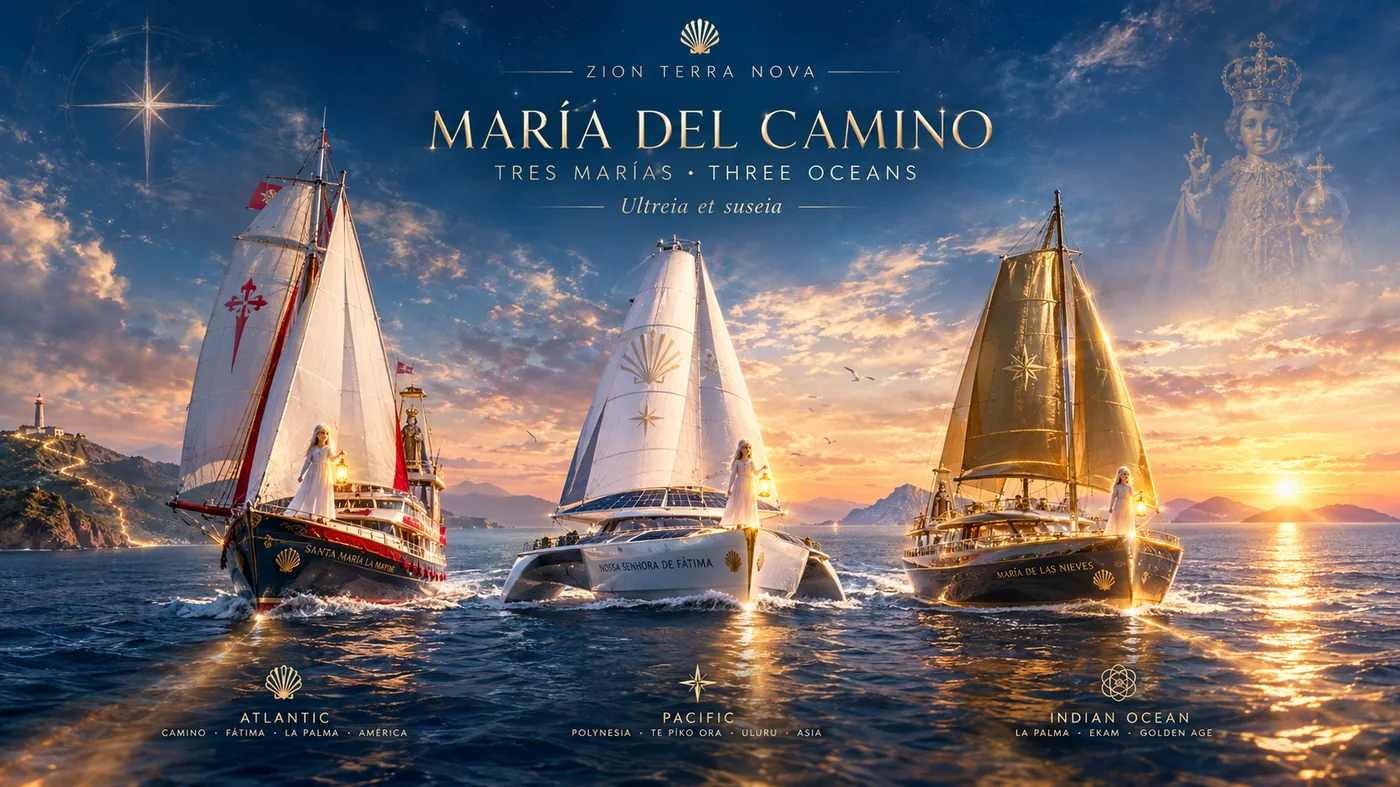
María del Camino — Tres Marias (mořské Camino · solární plachty)
L5 Free World · osmý bod Terra Nova · Stav: 🔵 Příprava — plavidla ve výzkumné fázi
„Tam, kde starý svět končil u moře, nový pluje dál."
Záměr
María del Camino je osmý bod vrstvy L5 Free World — a jediný, který není místo. Je to cesta: flotila Tres Marias — tři lodě pro tři oceány, zhruba padesát poutníků na trup, které fyzicky spojují všech devět pevných bodů sítě.
Každý uzel Terra Nova nese do sítě jeden princip — Genesis nese zahradu, Dharma chrám, Te Pīko Ora oceán, Bohemia governance, Bodhi Lanka akášu, LUMI most mezi světy, Uluru paměť, Boa Esperança naději a Ekam dokončení. María del Camino nese spojení samotné — cirkulaci mezi body. Semenná knihovna, kulturní archiv, lidé a granty proudí mezi uzly přes moře, ne kurýrní službou.
Tři lodě — tres Marias
Flotila nese jména tří mariánských zjevení poutníkovy cesty — ta samá, která provázela zrození sítě:
| Loď |
Oceán |
Zjevení |
Roucho |
| Santa María la Mayor |
Atlantik |
Pontevedra — bazilika na pobřežním Caminu |
Červená královská roucha — španělská královna; zasvěcení poutníka |
| Nossa Senhora de Fátima |
Pacifik |
Fátima — Bílá Paní |
Svatební šaty — mystická svatba, bílá orchidej, nové zjevení |
| María de las Nieves |
Indický oceán |
La Palma — patronka ostrova i celé sítě |
Zlatá roucha — nedokončené zázraky, v náručí vzpřímené dítě |
- Santa María la Mayor (Atlantik) — klasická plachetnice v tradici Camina de Santiago. Domácí voda Galicie (Pontevedra ría — přístav, kde námořníci postavili Marii svou nejkrásnější stavbu), trasa Finisterre → Lisabon (odbočka po souši Tomar–Sabacheira) → La Palma → karibský břeh LUMI; severský výběžek umí říční leg Labem k Bohemii.
- Nossa Senhora de Fátima (Pacifik) — solární katamarán v linii wa'a kaulua, polynéské dvojité kánoe, kterou nesla Hōkūleʻa a celá wayfinding kultura. Domov v Te Pīko Ora (Raiatea); trasa Kostarika → Polynésie → australské pobřeží → Srí Lanka → Ekam.
- María de las Nieves (Indický oceán) — třetí loď, loď nedokončených zázraků. Nese třetí zjevení: María ve zlatých rouchech drží vzpřímené dítě — malého prince, symbol Zlatého věku (v příběhu sítě dítě LUMI a Elizabeth). Patronka La Palmy je zároveň patronkou celého ZIONu — proto právě ona dostává oceán, kde cesta vrcholí: Ekam → Boa Esperança → návrat do Atlantiku.
Tři Marie se nescházejí uprostřed moře — jejich světy se dotýkají na švech světa: na šíji Amerik (LUMI — atlantická × pacifická výměna po souši) a na švu oceánů u Mysu dobré naděje (Boa Esperança — atlantická × indická). Credencial sbírá razítka „tří moří".
Patron flotily — Malý princ a Elizabeth
Patronem cest všech tří Marií je Malý princ — dítě ze zlatého zjevení na La Palmě, jehož tváří je Pražské Jezulátko: dítě-král v rouše a korunce, jež v dlani drží celý svět. Dítě, které kdysi poputovalo ze Španělska do Prahy — ze země moří do země bez moře — se teď na lodích vrací na vodu.
- Každý trup jej nese ve své barvě — červeném rouše na Santa María la Mayor, bílém na Nossa Senhora de Fátima, zlatém na María de las Nieves; tak, jak se Jezulátko po staletí obléká do liturgických barev.
- Svět v dětské dlani — jablko s křížkem čteme jako planetu nesenou v ruce dítěte: zrod nového světa, ne jeho dobytí.
- Patron, který už plul — obraz Dítěte přeplul Pacifik na manilské galeoně (Santo Niño de Cebú, 1521/1565); pacifický trup jde jeho trasou. V příběhu sítě je Malý princ dítětem linie LUMI — Elizabeth — a zároveň platí: každý z nás je malý princ, když se plně probudí.
Elizabeth — dívka s lucernou. Matka-linie Malého prince je Elizabeth — Alžběta, po babičce, ne po hvězdě. Její jméno znamená „Bůh je má přísaha": ne titul, ale slib. V příběhu sítě je to dítě, které na přídi archy ukázalo na první paprsek světla; rybářova dcera, jež na hřebeni nad mořem složila jméno Issobella — „krásná všemi směry stejně" — nevěda, že nese své vlastní, protože v jižní řeči zní Elizabeth jako Isabel. U brány OASIS stojí jako kněžka s lucernou vedle Rádhy: drží světlo pro ty, kdo přijdou za sto let, a ptá se každého příchozího, co po něm zůstane. Její lucerna ukazuje dvě věci — co by mohlo být, a co skutečně je. Matka nese světlo, dítě nese svět — proto stojí na přídi spolu.
Jméno
Program nese jméno María del Camino — Marie Cesty, mariánské svatyně stojící přímo na Camino Francés u Leónu. Tisíc let chodili poutníci do Santiaga; kdo šel skutečně do kraje, pokračoval na Finisterre — finis terrae, konec země — kde cesta končila u oceánu a nebylo kam jít dál.
María del Camino je přesně ten krok navíc: Camino, které u moře nekončí, ale na něm pokračuje. A předehra se naplnila — tři zjevení z poutníkovy cesty se stala třemi loděmi; loď bez plachet ze staré legendy se stala flotilou, jejíž plachty jsou světlo.
„Ultreia et suseia — vpřed a výš." — pozdrav poutníků z Codex Calixtinus, motto flotily.
Co plavidlo drží (koncept)
- Solární plachty — plachty samotné jsou fotovoltaické: flexibilní solární články laminované do plachtoviny (odhad 60–200 kWp) plus hydroregenerace pod plachtami. Cíl: plavba bez fosilních paliv.
- ~50 osob na trup — permanentní posádka Guardianů plus rotující residenti: výzkum, programy youth bridge, praktici Medical Table, noví Guardiani v tranzitu mezi uzly.
- Soběstačnost — odsolování a sběr deště, hydroponická palubní zahrada, zásoby vyměňované v uzlech — k tomu trasa je.
- Guardian node na moři — plný ZION uzel validující přes satelit, LoRa/mesh gateway na stěžni a treasury, kterou umí loď fyzicky doručit: humanitární náklad mezi uzly.
- Pilgrim credential — každý úsek je etapa; posádka i residenti sbírají on-chain razítka jako poutníčková credencial, za celý okruh compostela — razítko tří moří.
Velká cesta — obeplutí jako iniciace
Trasa není servisní okruh — je to cesta, kde každý uzel je jedna iniciace. Dvanáct zastávek, tři oceány, tři lodě — a návrat jiným člověkem. Štafeta se předává na švech světa: atlantická Marie podává pacifické v LUMI, pacifická indické u Ekamu, indická se vrací s atlantickou na Mysu.
| # |
Zastávka |
Iniciace |
Loď |
Co se děje |
| 0 |
Pontevedra · Galicie |
Poutník |
I |
Vyplutí z domácího přístavu — bazilika María Mayor, credencialy, plamen z Finisterra |
| 1 |
Genesis Garden · Sabacheira, Tomar |
Země |
I |
Ruce v hlíně — práce v zahradě, zdroj, semínka; Albergue do Jardim: carimbo Zahrady do credencialu = kvalifikace k nástupu na palubu |
| 2 |
Dharma Temple · La Palma |
Ticho |
I |
Ostrov třetího zjevení — chrámová praxe pod patronkou sítě |
| 3 |
LUMI · Nová Amerika |
Most |
I→II |
Šíje po souši (Camino de Cruces) — předání mezi oceány, výměna posádky i nákladu |
| 4 |
Te Pīko Ora · Raiatea |
Oceán |
II |
Wayfinding škola — hvězdná navigace, wa'a tradice |
| 5 |
Uluru · Austrálie |
Paměť |
II |
Pobřežní návštěvy na podmínky custodiánů — naslouchání songlines |
| 6 |
Bodhi Lanka · Srí Lanka |
Akáša |
II |
Služba a archiv — znalostní uzel před posledním skokem |
| 7 |
Ekam · Indie |
Dokončení |
II→III |
Kotviště Chennai, po souši na kampus Oneness — satori na jediném postaveném uzlu |
| 8 |
Indický oceán |
Návrat |
III |
María de las Nieves přebírá — monzunová trasa, kde cesta vrcholí obratem |
| 9 |
Boa Esperança · Mys |
Obrat |
III |
Scháziště flotily na švu oceánů — bouře přejmenována na naději |
| 10 |
St Helena → Azory → Pontevedra |
Integrace |
III→I |
Návratový oblouk — oceánská compostela, plný credencial tří moří |
| 11 |
Zlatá republika · Bohemia |
Governance |
domů |
Poslední razítko v srdci — po osvícení sekat dříví, nést vodu |
Loď nedokončených zázraků nese poutníky domů — protože satori se dokazuje návratem, ne odchodem.
Fáze rozvoje
| Fáze |
Název |
Popis |
| 0 |
Kresba |
Design study, partnerství se sail-training a NGO flotilami, odhad CAPEX/OPEX |
| 1 |
První etapa |
Pilotní trasa na charterované lodi mezi dvěma uzly — důkaz Guardian node at sea, mesh sync, program posádky — ještě před vlastním trupem |
| 2 |
Atlantický trup |
Refit nebo stavba Santa María la Mayor — klasická plachetnice; flag state, certifikace, pojištění |
| 3 |
Atlantický okruh |
První okruh atlantické trasy (Finisterre → La Palma → Karibik → LUMI); výměna semen a knihovny živě |
| 4 |
Pacifický trup |
Stavba/refit Nossa Senhora de Fátima — solární katamarán; pacifický home port, LUMI exchange protokol |
| 5 |
Indický trup |
María de las Nieves — třetí loď zavírá trojúhelník Atlantik–Pacifik–Indický; trasa dokončení Ekam → Cape → domov |
Proč právě teď
Síť deseti bodů je konstelace. Konstelace potřebuje cestovatele, aby se stala příběhem — někdo mezi hvězdami musí jít, nebo plout. Loď dělá příslib L5 fyzickým: ne mapu míst, ale živou trasu. Na palubě je celý pentagram v malém — zahrada, chrám, oceán, kruh, archiv — takže kdo nastoupí, už je všude. A tři Marie nesou tři zjevení kolem světa — červená královna, bílá nevěsta a zlatá matka s dítětem.
María del Camino — Tres Marias (the sea Camino · solar sails)
L5 Free World · the eighth point of Terra Nova · Status: 🔵 Preparation — vessels in the research phase
"Where the old world ended at the sea, the new one sails on."
Purpose
María del Camino is the eighth point of the L5 Free World layer — and the only one that is not a place. It is the way itself: the Tres Marias fleet — three ships for three oceans, roughly fifty pilgrims per hull — physically connecting all nine fixed points of the network.
Every Terra Nova node carries one principle into the network — Genesis carries the garden, Dharma the temple, Te Pīko Ora the ocean, Bohemia governance, Bodhi Lanka akasha, LUMI the bridge between worlds, Uluru memory, Boa Esperança hope and Ekam completion. María del Camino carries connection itself — circulation between the points. The seed library, the cultural archive, people and grants flow between the nodes over the sea, not by courier.
Three ships — tres Marias
The fleet carries the names of the three Marian apparitions of the pilgrim's journey — the same three that accompanied the birth of the network:
| Ship |
Ocean |
Apparition |
Robes |
| Santa María la Mayor |
Atlantic |
Pontevedra — the basilica on the coastal Camino |
Red royal robes — the Spanish queen; the pilgrim's initiation |
| Nossa Senhora de Fátima |
Pacific |
Fátima — the White Lady |
Wedding dress — the mystical wedding, the white orchid, the new apparition |
| María de las Nieves |
Indian Ocean |
La Palma — patroness of the island and the whole network |
Golden robes — unfinished miracles, the upright child in her arms |
- Santa María la Mayor (Atlantic) — a classic sailing ship in the Camino de Santiago tradition. Home waters Galicia (the Pontevedra ría — the port where seafarers built Mary their most beautiful church), route Finisterre → Lisbon (overland detour to Tomar–Sabacheira) → La Palma → LUMI's Caribbean shore; a northern sortie can run up the Elbe to Bohemia.
- Nossa Senhora de Fátima (Pacific) — a solar catamaran in the wa'a kaulua line, the Polynesian double canoe carried by Hōkūleʻa and the whole wayfinding culture. Home at Te Pīko Ora (Raiatea); route Costa Rica → Polynesia → Aboriginal Australia → Sri Lanka → Ekam.
- María de las Nieves (Indian Ocean) — the third ship, the ship of unfinished miracles. She carries the third apparition: Mary in golden robes holding the upright child — the little prince, the symbol of the Golden Age (in the network's story, the child LUMI and Elizabeth). The patroness of La Palma is also the patroness of all of ZION — which is why she is given the ocean where the journey reaches its summit: Ekam → Boa Esperança → the return to the Atlantic.
The three Marys do not meet mid-ocean — their worlds touch at the seams of the world: on the isthmus of the Americas (LUMI — Atlantic × Pacific exchange overland) and on the ocean seam at the Cape of Good Hope (Boa Esperança — Atlantic × Indian). The credencial collects the "three seas" stamps.
Patron of the fleet — the Little Prince and Elizabeth
The patron of all three Marys' journeys is the Little Prince — the child of the golden apparition on La Palma, whose face is the Infant Jesus of Prague: the child-king in robes and crown, holding the whole world in his little palm. The child who once travelled from Spain to Prague — from a land of seas to a land without one — now sails back to the water aboard the fleet.
- Each hull carries him in its own colour — red robes aboard Santa María la Mayor, white aboard Nossa Senhora de Fátima, gold aboard María de las Nieves — just as the Infant has been dressed in liturgical colours for centuries.
- The world in a child's palm — the orb is read as the planet carried in a child's hand: the birth of a new world, not its conquest.
- A patron who has already sailed — an image of the Child crossed the Pacific on a Manila galleon (Santo Niño de Cebú, 1521/1565); the Pacific hull follows his route. In the network's story the Little Prince is the child of the LUMI — Elizabeth — line, and at the same time: each of us is the little prince, once fully awake.
Elizabeth — the girl with the lantern. The mother-line of the Little Prince is Elizabeth — Elizabeth after her grandmother, not after a star. Her name means "God is my oath": not a title, but a promise. In the network's story she is the child who pointed at the first ray of light from the ark's prow; the fisherman's daughter who composed the name Issobella on the ridge above the sea — "beautiful in every direction alike" — not knowing she carried her own, for in the southern tongue Elizabeth sounds as Isabel. At the OASIS gate she stands as the priestess with the lantern beside Rádha: she holds the light for those who will come a hundred years from now, and asks every arrival what will remain of them. Her lantern shows two things — what could be, and what truly is. The mother carries the light, the child carries the world — which is why they stand on the prow together.
The name
The programme carries the name María del Camino — Mary of the Way, the Marian sanctuary standing directly on the Camino Francés near León. For a thousand years pilgrims walked to Santiago; whoever truly went to the end continued to Finisterre — finis terrae, the end of the earth — where the road ended at the ocean and there was nowhere left to walk.
María del Camino is exactly that one step further: a Camino that does not end at the sea but continues on it. And the foreshadowing has been fulfilled — the three apparitions of the pilgrim's journey became three ships; the sail-less boat of the old legend became a fleet whose sails are light.
"Ultreia et suseia — onward and upward." — the pilgrims' greeting from the Codex Calixtinus, the fleet's motto.
What the vessel holds (concept)
- Solar sails — the sails themselves are photovoltaic: flexible solar cells laminated into the sailcloth (est. 60–200 kWp) plus hydro-regeneration beneath the sails. The goal: fossil-free sailing.
- ~50 souls per hull — a permanent Guardian crew plus rotating residents: research, youth-bridge programmes, Medical Table practitioners, new Guardians in transit between nodes.
- Self-sufficiency — desalination and rain catchment, a hydroponic deck garden, stores exchanged at the nodes — that is what the route is for.
- Guardian node at sea — a full ZION node validating over satellite, a LoRa/mesh gateway on the mast, and a treasury the ship can physically deliver: humanitarian cargo between the nodes.
- Pilgrim credential — each leg is an etapa; crew and residents collect on-chain stamps like the pilgrim's credencial, a compostela for the full circuit — the stamp of three seas.
The Great Route — circumnavigation as initiation
The route is not a service loop — it is a journey where each node is an initiation. Twelve stops, three oceans, three ships — and a return as someone else. The baton passes at the seams of the world: the Atlantic Mary hands off to the Pacific at LUMI, the Pacific to the Indian at Ekam, and the Indian meets the Atlantic again at the Cape.
| # |
Stop |
Initiation |
Ship |
What happens |
| 0 |
Pontevedra · Galicia |
The Pilgrim |
I |
Departure from the home port — the María Mayor basilica, credencials, the flame carried from Finisterre |
| 1 |
Genesis Garden · Sabacheira, Tomar |
Earth |
I |
Hands in the soil — work in the garden, the source, the seeds; Albergue do Jardim: the Garden stamp in the credencial qualifies a pilgrim to enter the boarding process |
| 2 |
Dharma Temple · La Palma |
Silence |
I |
The island of the third apparition — temple practice under the network's patroness |
| 3 |
LUMI · Nová Amerika |
The Bridge |
I→II |
The isthmus overland (Camino de Cruces) — the handoff between oceans, crew and cargo exchange |
| 4 |
Te Pīko Ora · Raiatea |
Ocean |
II |
The wayfinding school — star navigation, the wa'a tradition |
| 5 |
Uluru · Australia |
Memory |
II |
Coastal visits on the custodians' terms — listening to the songlines |
| 6 |
Bodhi Lanka · Sri Lanka |
Akasha |
II |
Service and archive — the knowledge node before the final hop |
| 7 |
Ekam · India |
Completion |
II→III |
Anchorage at Chennai, overland to the Oneness campus — satori at the only built node |
| 8 |
Indian Ocean |
The Return |
III |
María de las Nieves takes the pilgrims aboard — the monsoon route where the journey turns |
| 9 |
Boa Esperança · the Cape |
The Turn |
III |
The fleet rendezvous on the seam of oceans — the storm renamed hope |
| 10 |
St Helena → Azores → Pontevedra |
Integration |
III→I |
The homeward arc — the oceanic compostela, a complete three-seas credencial |
| 11 |
Golden Republic · Bohemia |
Governance |
home |
The last stamp in the heartland — after enlightenment, chop wood, carry water |
The ship of unfinished miracles carries the pilgrims home — because satori is proven by returning, not by leaving.
Development phases
| Phase |
Name |
Description |
| 0 |
The drawing |
Design study, partnerships with sail-training and NGO fleets, CAPEX/OPEX estimate |
| 1 |
First etapa |
A pilot route on a chartered vessel between two nodes — proof of the Guardian node at sea, mesh sync, the crew programme — before any owned hull |
| 2 |
Atlantic hull |
Refit or build of Santa María la Mayor — the classic sailing ship; flag state, certification, insurance |
| 3 |
Atlantic circuit |
The first circuit of the Atlantic route (Finisterre → La Palma → the Caribbean → LUMI); live seed and library exchange |
| 4 |
Pacific hull |
Build or refit of Nossa Senhora de Fátima — the solar catamaran; Pacific home port, the LUMI exchange protocol |
| 5 |
Indian hull |
María de las Nieves — the third ship closes the Atlantic–Pacific–Indian triangle; the completion route Ekam → the Cape → home |
Why now
A network of ten points is a constellation. A constellation needs travellers to become a story — someone must walk, or sail, between the stars. The ship makes the promise of L5 physical: not a map of places but a living route. The whole pentagram is aboard in miniature — garden, temple, ocean, circle, archive — so whoever steps aboard is already everywhere. And the three Marys carry the three apparitions around the world — the red queen, the white bride and the golden mother with her child.