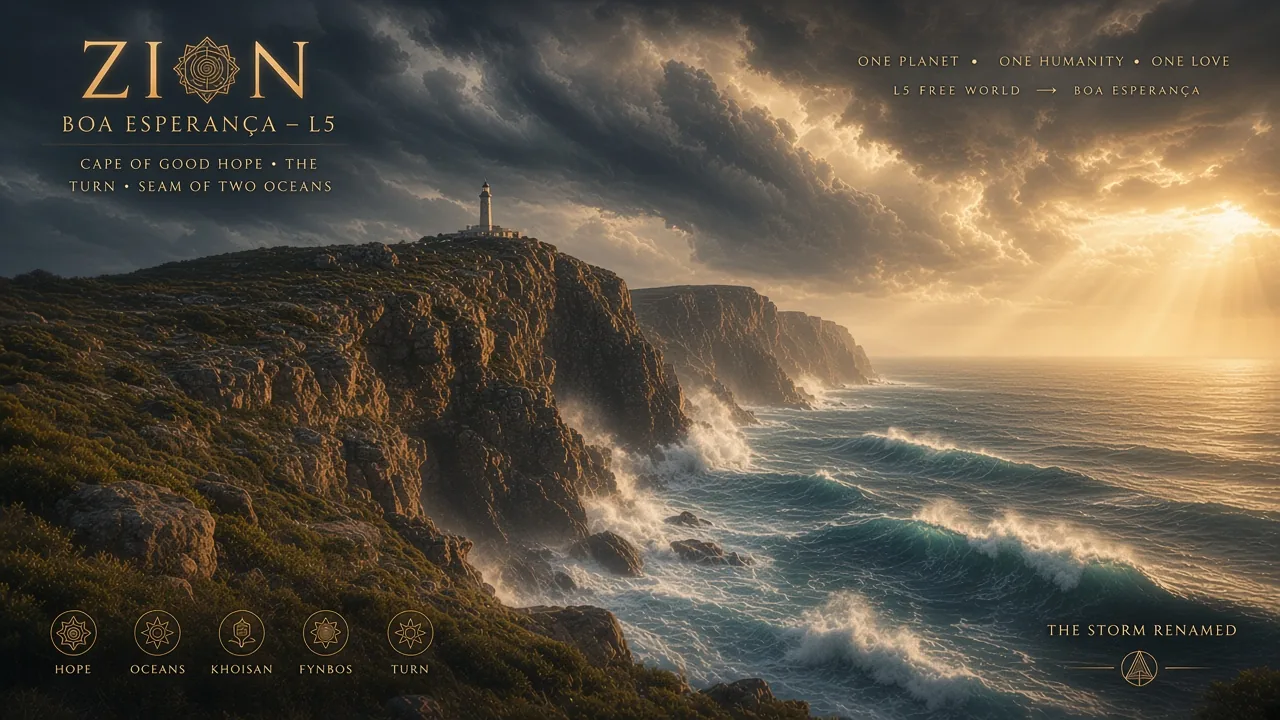
Boa Esperança — Mys dobré naděje (Jihoafrická republika)
L5 Free World · devátý bod Terra Nova · Stav: 🟣 Vize — uzel jako vztah, ne stavba
„Mys bouří dostal své jméno od strachu. Dobrou naději od toho, co za ním stojí."
Záměr
Boa Esperança je devátý bod vrstvy L5 Free World — a záměrně je to vize, ne stavební plán. Mys dobré naděje je druhý „šev světa": první je Panamská šíje u LUMI, kde se oceány překládají po souši; druhý je tu, jediné místo, kde se dvě Marie mohou setkat na vodě.
Roku 1488 Bartolomeu Dias objel mys v bouři a pojmenoval ho Cabo das Tormentas — Mys bouří. Král Jan II. ho přejmenoval na Boa Esperança — protože to, co vypadalo jako zeď na konci světa, otevřelo mořskou cestu do Indie. Toto přejmenování je samotný princip uzlu: bouře se stává nadějí tím, co za ní je.
Princip: obrat domů
Každý uzel nese jednu iniciaci na Velké cestě flotily María del Camino. Boa Esperança nese Obrat — moment, kdy se poutník po dokončení v Ekamu otáčí domů:
- Storm passage — Roaring Forties jsou nejhorší vody plachetního světa; hřbitov lodí, domov legendy Flying Dutchmana. Guardian zde prochází poslední zkouškou: naučit se, že naděje je navigační nástroj, ne pocit.
- Agulhas — pravý sever — Cape Agulhas (~150 km východně) je přesný geografický šev Atlantiku a Indického oceánu. Jeho jméno znamená „jehly" — kolem r. 1500 tu střelka ukazovala skutečný sever a námořníci kalibrovali kompasy. Na švu dvou oceánů se jehla přiměřuje pravdě.
- Návrat jako důkaz — satori z Ekamu se nedokazuje zůstáním; dokazuje se návratem. Mys je bod, kde se cesta otáčí domů.
Nejstarší lidská linie
Mys drží kořen hlubší než jakýkoli jiný uzel:
- Khoisan — původní lidé jihoafrického pobřeží; pravděpodobně nejstarší kontinuální lidská linie planety. Uluru drží nejstarší songlines — Mys drží nejstarší rodokmen.
- Blombos Cave (~75–100 tisíc let) — nejstarší známé ochrové rytiny a mušlové korálky: kolébka symbolického myšlení lidstva.
Uzel proto funguje jako Uluru — FPIC: žádná aktivita bez svobodného, předem daného a informovaného souhlasu custodiánských komunit; znalosti zůstávají u nositelů; žádná tokenizace dědictví.
Zahrada na švu oceánů
- Fynbos — Cape Floristic Region: nejmenší, ale na druhy nejbohatší florální říše planety (šest říší světa — jedna celá je jen tady).
- Great African Seaforest — kelpové lesy False Bay (My Octopus Teacher se natáčel přímo zde). Uzel spojuje zahradu nad hladinou s lesní zahradou pod ní.
- Day Zero laboratoř — Cape Town v roce 2018 málem vyschol a kolektivní vodní disciplínou to ubránil. Naděje jako praktikovaný protokol — know-how pro vodní resilience celé sítě L5.
- Robben Island — ostrov exilu, kde Mandela strávil 18 let a vyšel s odpuštěním. Osvobození skrze odpuštění — druhá tvář dokončení.
Role ve flotile
- Scháziště trupů na vodě — atlantická María del Camino pluje z jihu nahoru, pacifická María del Pacífico z Indie dolů; potkají se tam, kde se potkávají oceány.
- Útočiště a resupply — bezpečný přístav před/po nejtěžších legech Velké cesty.
- Jihoafrický partner arc — vztah s ekokomunitami Western Cape, mořskou vědou a Khoisan custodiány.
Fáze rozvoje
| Fáze |
Název |
Popis |
| 0 |
Vztah |
Dialog s Khoisan custodiány a ekokomunitami Western Cape — uzel existuje jako vzájemné učení, ne stavba. |
| 1 |
Pobřežní kruh |
Malý uzlový kruh — fynbos zahrada, kelp program, vodní lab; custodiáni vedou vše, co se týká jejich země a příběhů. |
| 2 |
Přístavní protokol |
Domluva kotviště a resupply pro flotilu — logistika Velké cesty, sezónní okna Roaring Forties. |
| 3 |
Scháziště |
První setkání obou trupů na švu oceánů — ceremonie obratu, credencial razítko „bouře přejmenována". |
Proč právě teď
Velká cesta potřebovala svůj obratný bod. Flotila potřebovala místo, kde se oba oceány — a obě Marie — fyzicky setkají. A síť potřebovala vzpomínku na to, že nejstarší věc lidstva je naděje, která přejmenuje bouři.
Boa Esperança — Cape of Good Hope (South Africa)
L5 Free World · ninth point of Terra Nova · Status: 🟣 Vision — a node as relationship, not construction
"The Cape of Storms was named by fear. Good Hope was named by what lay beyond it."
Intent
Boa Esperança is the ninth point of the L5 Free World layer — and deliberately a vision, not a construction plan. The Cape of Good Hope is the second "seam of the world": the first is the Panama isthmus at LUMI, where oceans are crossed overland; the second is here — the only place the two Marias can meet at sea.
In 1488 Bartolomeu Dias rounded the cape in a storm and named it Cabo das Tormentas — the Cape of Storms. King John II renamed it Boa Esperança — because what looked like a wall at the end of the world had opened the sea road to India. That renaming is the node's principle itself: the storm becomes hope through what lies beyond it.
Principle: the turn homeward
Every node carries one initiation on the María del Camino Great Route. Boa Esperança carries the Turn — the moment the pilgrim, after completion at Ekam, turns home:
- Storm passage — the Roaring Forties are the hardest waters in sailing; a graveyard of ships, home of the Flying Dutchman legend. The Guardian faces the final trial here: learning that hope is a navigational instrument, not a feeling.
- Agulhas — true north — Cape Agulhas (~150 km east) is the precise geographic seam of the Atlantic and Indian Oceans. Its name means "needles" — around 1500 the compass needle read true north there and sailors calibrated their compasses. At the seam of two oceans, the needle is adjusted to truth.
- Return as proof — the satori of Ekam is not proven by staying; it is proven by coming home. The Cape is where the journey turns homeward.
The oldest human lineage
The Cape holds a root deeper than any other node:
- Khoisan — the first people of the South African coast; arguably the oldest continuous human lineage on the planet. Uluru holds the oldest songlines — the Cape holds the oldest ancestry.
- Blombos Cave (~75–100 thousand years) — the oldest known ochre engravings and shell beads: the cradle of symbolic thought in humanity.
The node therefore works like Uluru — FPIC: no activity without the free, prior and informed consent of custodian communities; knowledge stays with its holders; no tokenization of heritage.
A garden on the seam of oceans
- Fynbos — the Cape Floristic Region: the smallest yet richest-per-area floral kingdom on Earth (six kingdoms worldwide — one of them exists only here).
- The Great African Seaforest — the kelp forests of False Bay (My Octopus Teacher was filmed right here). The node joins a garden above the waterline to a forest garden beneath it.
- Day Zero lab — Cape Town nearly ran dry in 2018 and collective water discipline prevented it. Hope as a practised protocol — know-how for water resilience across the L5 network.
- Robben Island — the island of exile where Mandela spent 18 years and walked out carrying forgiveness. Liberation through forgiveness — the other face of completion.
Role in the fleet
- Hull rendezvous at sea — the Atlantic María del Camino sails up from the south, the Pacific María del Pacífico down from India; they meet where the oceans meet.
- Refuge and resupply — safe harbour before/after the hardest legs of the Great Route.
- South African partner arc — relationships with Western Cape eco-communities, marine science and Khoisan custodians.
Phases
| Phase |
Name |
Description |
| 0 |
Relationship |
Dialogue with Khoisan custodians and Western Cape eco-communities — the node exists as mutual learning, not construction. |
| 1 |
Coastal circle |
A small node circle — fynbos garden, kelp program, water lab; custodians lead everything touching their land and stories. |
| 2 |
Harbour protocol |
Anchorage and resupply arrangements for the fleet — Great Route logistics, Roaring Forties seasonal windows. |
| 3 |
The Rendezvous |
First meeting of both hulls on the seam of oceans — the turning ceremony, the credential stamp "the storm renamed". |
Why now
The Great Route needed its turning point. The fleet needed a place where both oceans — and both Marias — could physically meet. And the network needed a reminder that the oldest thing in humanity is the hope that renames the storm.